Pages

Showing posts with label 2011 Reading Challenge. Show all posts

Thursday, February 24, 2011

2011 Reading Challenge: Book 05 and 06

After falling off the reading train for a few weeks because of New Covenant Theology, I managed to catch it again with the encouragement of a twenty-five cent library sale last Saturday.  I picked up two books I'd been semi-interested in for a while: Mommie Dearest by Christina Crawford, and 'Tis by Frank McCourt.

Mommie Dearest is about Joan Crawford's relationship with her daughter, Christina Crawford.  Joan adopted Christina when she was a baby and gave her a very privileged childhood.  Christina always had her basic needs for food, clothing, and shelter met, and was well educated.  Unfortunately, Joan was an alcoholic, physically and verbally abusive.  This book chronicles her life through Joan's funeral.

Limerick, Ireland (from Wikipedia)
'Tis is the sequel to Frank McCourt's Angela's Ashes.  Angela's Ashes is about Frank's childhood in Limerick, Ireland; he grew up desperately poor, often going without food and clothing.  Two of his brothers and his one sister died in childhood, and his father typically used all their money to buy beer, before finally leaving his wife (Angela) and children when Frank was eleven years old.  Frank dropped out of school after 8th grade to support his mother and brothers.  He dreamed of going to America to live a better life.  At the end of Angela's Ashes, he finally manages to get there.  'Tis begins with his first few days in America and ends with Angela's death (hence the title of the first book, Angela's Ashes).


These two books are somewhat similar theme-wise.  Both books are about mothers, and their children's frustrations. Joan Crawford was always abusive and seemed to have a huge power complex, and this obviously made Christina's life pretty difficult to manage.  Especially during her highschool and college years, Christina hated her mother.  On the other hand, Angela was always kind and cared for her children as well as she could, even swallowing her pride and begging for food when it became necessary.  Angela never had much, even as a child, and she made good friends among the poorest people in Limerick.  She became more stubborn in her old age and didn't want to relinquish her old lifestyle and friends, even for the comforts that came with money from her sons.  This frustrated Frank because all he had ever wanted was to be accepted in middle class society, and his mother was happy to stay in the slums.

However, this is where the differences begin.  The two books are written in very different styles.  Mommie Dearest is written in a traditional, well-organized, autobiographical style, with correct grammar and "normal" syntax.  'Tis, on the other hand, is written stream of consciousness style, chronologically rather than by topic.  Frank rambles incessantly, using colorful language (not in a bad way :) ) and graphic imagery.

'Tis has been criticized because Frank is not a good or likeable person.  He lies, sleeps around, and spends lots of time drunk.  People say that this is a big difference from the original style in Angela's Ashes, but I don't agree.  In Angela's Ashes, Frank steals food from stores and orchards and money from his dead employer, and lies when it's in his best interests.  The main difference is that this is kind of cute when the person sinning is young, and it's easy to "excuse" when the person lives such a miserable life.  But in 'Tis, Frank is an adult who has his father's tendencies to drink excessively and generally sin a lot.  People are less forgiving when an adult sins.

'Tis is, as my mom puts it, "earthy," and definitely not for young audiences.  It deals with hard subjects with no Christian worldview.  Mommie Dearest is also not for young audiences, though you won't find as much adult subject matter in it.  There is quite a bit of language in both books - though there is less in Mommie Dearest, it strikes you more there because the book is fairly formal thoughout.

Overall, both of these books kept my attention, but I have to say that I enjoyed 'Tis more stylistically in spite of its drawbacks.

Next week: I'm going to try to finish New Covenant Theology.  Fingers crossed!

Sunday, February 6, 2011

2011 Reading Challenge: Book 04

I can't believe I'm already four books into this challenge!  So far, I've been finishing off books and series I had begun but lacked the impetus to finish.  It's been nice to get some of that done (and has gotten me thinking about the other projects I haven't finished yet).

This week, I read The Biblical View of Self-Esteem, Self-Love, and Self-Image by Jay Adams.  Self-esteem is an incredibly important issue in modern culture, particularly in schools.  The Banner reported that Christian schools are also promoting self-esteem:

In Grand Rapids 500 Christian school children from the fourth and fifth grades were given a week’s training in “how to recognize” their “true worth.”  They wrote essays on why they liked themselves (or didn’t), they acted out a skit called “A Pat on the Back,” and were told “feel good about yourselves.” (August 13, 1984)

Self-esteem teachings pervade many different areas of life.  For example, the Ladies Home Journal communicated that “feeling good about ourselves, in fact, may be the cornerstone of our total wellbeing” (“The Secret of Self-Esteem,” published February 1984).  One Christian author wrote that “I contend that this unfulfilled need for self-esteem underlies every act” (Robert H. Schuller, Self-Esteem: The New Reformation).  Doctors studied prison inmates and discovered that their self-esteem was higher than the average law-abiding citizen’s.

Because we, as Christians, are called to weigh every philosophy, thought, and action against the Bible, it is clear that the self-esteem movement can’t be ignored.  Is the self-esteem movement biblical?

When studying any theory, it is important to understand its origins.  The modern idea of self-esteem began with Alfred Adler and Abraham Maslow’s need theories.  These secular philosophers promoted the idea that our basic needs (food, shelter, safety, and love) must be met before we are capable of loving ourselves.  Once we love ourselves, we are able to love other people and God (see chapter 3 for a more in-depth analysis of Adler and Maslow’s theories).

Walter Trobisch writes in Love Yourself that

Self love is thus the prerequisite and the criterion for our conduct towards our neighbor . . . without self-love there can be no love for others . . . You cannot love neighbor, you cannot move God unless you first love yourself.

It’s clear that the modern idea of self-esteem became popularized through Adler and Maslow in the late 1800s and early 20th century.  When looking at new philosophies, it is important to see if they were mirrored anywhere in history, particularly in the Church.  Examining the history of a theory can give us valuable insight into the effects it will have and any refutations that historical philosophers have made.  To think that modern man is unilaterally correct and that historical people were simple country bumpkins – something C.S. Lewis called “chronological snobbery” – should be avoided at all costs.

Adams writes that “The only question that may rightfully concern us, according to God’s Word, is whether what [self-esteem advocates] say is correct.”  Let’s examine what the Bible has to say about self-esteem so we can determine if the modern self-esteem movement is biblical.

The essential factor in Maslow’s theory is that people are not motivated to meet the “higher” needs until the “lower” or more basic ones are met. (Lawrence Crabb, Effective Biblical Counseling)

If people are incapable of selfless thinking until their basic needs are met, then “man cannot be held responsible for obedience to the biblical commands to love God and his neighbor” (Adams 43).  Luke 10:42 says that “Only a few things are necessary, really only one.”  That need is salvation, found only in Jesus’ death and resurrection (“man does not live by bread alone”).

Obviously we are faced with a choice here.  Shall we continue to recognize the need theory of the Bible as the basis for our understanding of humanity, or shall we abandon it for the speculations of modern psychologists?

In Matthew 6, Jesus contrasts the “Gentile” (or pagan) philosophy of life with the Christian approach.  He observes that the pagan zealously seeks security in “things” (a prominent term in the chapter) that he thinks he “needs.”  … Yet rather than concluding that these needs are essential to higher-level activity . . . Jesus turns everything around and stands Maslow’s pyramid on its apex:

Seek first His kingdom and His righteousness, and all these things shall be added to you (Matthew 6:33).

. . . Paganism says, “I must have my lower-level needs satisfied first if you expect me to seek higher ends.”  Christ replies, “No, it will not be that way with my disciples.  They must put me and other members of my kingdom first.  All other matters are secondary.”

Christian proponents of self-esteem realize that, on some level, the Bible contradicts their teachings.  One way they seek to prove their theories is by using the second commandment in the New Testament (“you shall love your neighbor as you love yourself,” Matthew 22:39b).  If we are to love our neighbor as ourselves, surely we should focus on loving ourselves more and more so that we can love our neighbors better.

This can’t be true for two reasons.  First, it is clear from the surrounding verses that Jesus is giving two, and only two, commandments.  Second, nowhere in the rest of the Bible are we told to love ourselves more.  Scripture cannot contradict itself and remain infallible.

Paul “pre-supposes” self-love in Ephesians 5:28-29 when he tells husbands to “love your wives as you love your own body.”  Adams points out that “out of self-love we do not only good things, but all sorts of injurious and sinful things to ourselves: We commit adultery, we lie, we steal, we eat too much, we commit suicide” (71).  We are continually told to die to self (II Timothy 3:2, Matthew 16:24-25, Matthew 6, Matthew 10:37).

The biggest problem I have with the self-esteem movement is its view of man.  Christian self-esteem advocates teach that we are of infinite worth because Jesus came to die for us.  Not true!  If we claim that we are valuable, we deny the full extent of God’s grace.  Jesus came to die for us in spite of our inadequacy and inherently sinful natures.  (Consider Job 25:5-6, Micah 6:8, Matthew 18:12 and 23:12, Romans 3:10-18, I Corinthians 1:28-19, and Galatians 6:14, to name a few [93]).

Adams summarizes the entire book well: “In His amazing grace and undeserved love, God cares for man.  The great fact is that the Scriptures everywhere point us to the grace of God and not to the worth of man.”

I recommend this book to everyone.  It’s a quick read (about 140 pages), written in an easily understood style and supported by good scholarship and lots of sources and citations. You can order a copy used on Amazon for $0.01, and it will be the best cent (plus shipping/handling :) ) that you've ever spent.

“[Christ] died for all, that they who live should no longer live for themselves but for Him who died and rose again on their behalf.” – II Corinthians 5:15

Next week: New Covenant Theology by Tom Wells and Fred Zaspel

Saturday, January 29, 2011

2011 Reading Challenge: Book 03

Book Title & Author: Disciplines of a Godly Family by Kent and Barbara Hughes
Published: 1995

Justin and I were given this book for Christmas by a young married couple that we do a Bible study with.  They don't have children, and neither do we, so this review will be largely theoretical and theological rather than practical.

The purpose of Disciples of a Godly Family is to help parents realize "the hope that their children will come to know Christ early and will go on to full lives of service" (preface).  To this end, we are given a laundry list of things that families should do in order to teach their children how to live, including topics about how to build a family, how to cultivate a family's spiritual life, and everyday living.  There is an extensive appendix which gives the reader practical instructions about a wide range of topics, from how to use an advent tree to "Common-sense Tips Regarding Discipline."

I realize that the Hughes parents were trying to encourage Christians that good, functional families actually exist, but occasionally the book seemed arrogant.  For example, in the preface, the Hughes write that "We are not perfect parents with model children, though today they are all exemplary Christians.  Rather, ours is an eloquent witness that imperfect people, from less than perfect backgrounds, can by God's grace raise a joyous Christian family.  What we share is personal, an intimate album of childrearing.  It is our family's gift to you."  I get what they're trying to say, but it nevertheless rubs me the wrong way.

I had never before heard the idea that "doubt is a part of living faith" and "a part of faith," and I'm not completely sure that I agree with this idea (64, 65).  It's certain that all Christians doubt, but the Hughes almost seemed embrace it.  I agree that everyone will have his doubts at some point, and that all things work together for God's glory and our good (including doubts).  Nevertheless, doubt is a product of the fallen world - something that springs from our own sin.  There is nothing righteous about doubt.  Of course, we can and should try to handle doubt with biblical encouragement, fellowship, and exhortation.

There were more points of theology that I disagreed with, which wasn't surprising since Justin and I are the only non-Presbyterians in an all-Presbyterian circle.  :)

Overall, I would recommend this book as an interesting and quick read.  I definitely didn't agree with every argument or practice the book presented, and I didn't learn anything ground-breaking, but there was a lot of solid content and mostly good theology.

Next week: The Biblical View of Self-Esteem, Self-Love, and Self-Image by Jay E. Adams

Sunday, January 23, 2011

2011 Reading Challenge: Book 02


Book Title & Author: Odd Hours by Dean Koontz

Published: 2008

 After last week's book, I thought I would finish out the Odd Thomas series with Odd Hours.  My hopes were not high, since the books have steadily been declining in quality - unfortunately, I was right.  This book has very few compelling parts.  The characters were mundane and flat, the plot frail, and the world inconsistent. Thankfully, the writing is still somewhat engaging, though that doesn't nearly make up for the failings.

In the first book (Odd Thomas), Koontz introduced a wide range of characters and fleshed them out as much as was humanly possible.  He even managed to give the dead characters a lot of personality, which is an accomplishment since they aren't able to communicate with anyone.  I remember insignificant people, like the cashier at the gas station (who appeared for less than a page) and the nurse (who appeared for maybe two pages).  Unfortunately, in Odd Hours, you feel forced to like the characters.  Everyone seems to be an unremarkable, one-dimensional stereotype, and no one insignificant appears at all - even Odd acted completely out of character.

Skip this paragraph if you don't want me to spoil the plot for you.  :) Odd needs to stop bad guys from releasing nuclear bombs on four major American cities.  There's a young pregnant woman who is important for some reason (we never find out why), and that's it.  No more plot explanation is necessary.  There's no mystery, except that I still don't know why I was supposed to care about the bombs going off.  Yes, it's wrong to kill millions of innocent people, but we were never even told what cities the bad guys were hoping to destroy.  Odd never even knew.  So we're left wondering... why in the world do I care about this?  Because Odd doesn't know anyone in the cities, neither do we, and so we aren't invested in preventing this disaster.

In addition to these massive failings, Koontz keeps breaking his own rules.  Odd has a ghost dog (animals are never, ever ghosts); a ghost consistently and successfully communicated with him; and in previous books, ghosts were either malevolent or not, a rule which was completely disregarded.  When the author disregards the rules he set for his own universe, you know something's wrong.

The best part about the Odd Thomas series is his view on life: "Although weaponless, I left the house by the back door, with two chocolate-pumpkin cookies.  It's a tough world out there, and a man has to armor himself against it however he can" (58).  Koontz likes to poke fun at himself and at the foibles of humanity.  Unfortunately, there are far fewer instances of this here than in previous books.

Sometimes, I think that Koontz is right on about the world:

"When I am battered and oppressed by the world that humanity has made -- which is different from the world that it was given -- my primary defense, my consolation, is the absurdity of that world.


"The given world dazzles with wonder, poetry, and purpose.  The man-made world, on the other hand, is a perverse realm of ego and envy, where power-mad cynics make false idols of themselves and where the meek have no inheritance because they have gladly surrendered it to their idols in return not for lasting glory but for an occasional parade, not for bread but for the promise of bread.

"A species that can blind itself to truth, that can plunge so enthusiastically along roads that lead nowhere but to tragedy, is sometimes amusing in its recklessness, as amusing as the great movie comedians like Buster Keaton, Laurel and Hardy, and the many others who knew that a foot stuck in a bucket is funny, that a head stuck in a bucket is funnier, and that trying stubbornly to move a grand piano up a set of stairs obviously too steep and narrow to allow success is the hilarious distillation of the human experience.

"I laugh with humanity, not at it, because I am as big a fool as anyone, and bigger than most.  I style myself as a paladin for both the living and for the lingering dead, but I have been stuck in more than my share of buckets" (119).

God created the world, and it was perfect.  We create things, and unfortunately they break regularly.  It's better to laugh than cry about our imperfections.

And finally, my favorite quote, which speaks for itself: "Those who choose to live criminal lives are not the brightest among us.  This truth inspires a question: If evil geniuses are so rare, why do so many bad people get away with so many crimes against their fellow citizens and, when they become leaders of nations, against humanity?  Edmund Burke provided the answer in 1795: 'The only thing necessary for the triumph of evil is for good men to do nothing.'  I would only add this: It is also essential that good men and women not be educated and propagandized into believing that real evil is a myth and that all malevolent behavior is merely the result of a broken family or a failed society's shortcomings, amenable to cure by counseling and by the application of new economic theory" (193).

Don't bother reading this book.  It was good enough that I finished it, hoping it would get better, but it doesn't.  I was interested in reading more Dean Koontz books, but now I wonder if it would just be a waste of time.  The first book (Odd Thomas) was so good that I had high hopes for the rest of the series.  Unfortunately, things just went from bad to worse.

Next week: Disciplines of a Godly Family by Kent and Barbara Hughes

Saturday, January 15, 2011

2011 Reading Challenge: Book 01

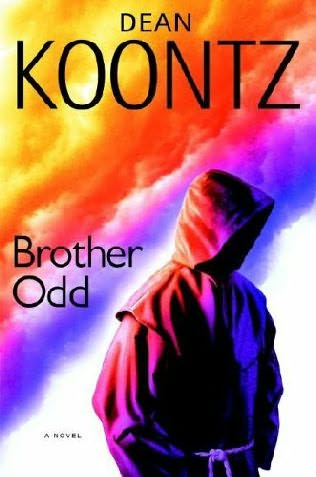
Book Title & Author: Brother Odd by Dean Koontz
Published: 2006

http://johndbrown.com/wp-content/uploads/2009/01/brother-odd-by-dean-koontz.jpg
The first time I remember hearing about Dean Koontz was when I bought one of his books for Justin's best man as a wedding gift.  Then, about six months later, Justin and I were in a used bookstore and saw a huge shelf of Dean Koontz books.  Justin knew that he enjoyed the Odd Thomas series, so we picked up a few.

They make great reading material for car trips.  I drive, Justin reads aloud, time flies!


But anyway, on to the book.  :)

Brother Odd is the third book in the Odd Thomas series.  The main character's first name is Odd and his last name is Thomas, hence the titles of the books.  In the first book, we learned that Odd can see the dead, usually those who have been killed and want justice.  He sees it as his duty to help them - since nobody else can see the dead, he's their last hope for peace.

In Brother Odd, Odd has gone to a monastery to get away from all the death in the world.  Of course, if that worked, it wouldn't be a very interesting book!  It's impossible for me to tell much about the plot, but it involves the supernatural and quantum mechanics.

These books are definitely not Christian, though they are thought-provoking.  Much like the Harry Potter books or The Chronicles of Narnia, the books are set in a world like this one, but with the difference that Odd Thomas can see dead people.  This has nothing to do with summoning people from beyond the grave or anything else demonic; instead, the ghosts just appear and need his help.  This allows the author to explore a huge variety of different characters with unique personalities and emotions.

Though you'll find the Odd Thomas books in the horror section, I would recommend them to people who don't typically enjoy horror stories.  They're a little creepy sometimes, but they end with hope, unlike most horror books or movies. 

Overall, I recommend the Odd Thomas series, particularly the first book (Odd Thomas).  The second book wasn't quite as good, and the third one was better than the second one, but neither hold a candle to the first book.