Pages

Thursday, February 3, 2011

An Encouraging Exhoration

Justin wrote this e-mail to a friend earlier, and I thought it was so good that I asked for permission to post it here. I will be reviewing the book he mentions later this week.  Enjoy!

---

One of the things that has helped me keep my focus is The Biblical View of Self-Esteem, Self-Love, Self-Image by Jay E. Adams, which Lizzie and I have been reading through. It’s a good consideration and biblical analysis of the self-esteem movement, in particular the movement within the Christian psychology community. The long and short of it so far is that rather than being concerned with our own self-image and having a proper love for ourselves, we should be focused entirely on loving God. “Therefore do not be anxious, saying ‘What shall we eat?’ or ‘What shall we drink?’ or ‘What shall we wear?’ For the Gentiles seek after all these things, and your heavenly Father knows that you need them all. But seek first the kingdom of God and his righteousness, and all these things will be added to you” (Matthew 6:31-33).

Anyway, I just read a passage in this book that encouraged me and that I thought I should share with you. The context is Rom. 6:1-2, 11-13 and Col. 3:3, 5, 8-10; “Christian” self-esteem espousers use them selectively to validate their doctrine.

    True, Colossians 3 and Romans 6 tells us that as God looks at us “in Christ” our standing before Him as Judge is perfect; no fault can be found. We have been completely forgiven when we believed, and now God sees us as brand-new people in His Son. In Him all the old ways have gone and the new ways have come to stay. All that is wonderfully clear. But what is also clear is that Paul does not tell this to “make us feel good about ourselves” or to “give us strokes” or to “raise our self-esteem.” His purpose is to urge us to become in everyday living what we already are counted to be in Christ. In other words, he wants us to see that in ourselves we fall far short of what we are in Christ.
    Listen to Romans 6:1, 2:

What shall we say then? Are we to continue in sin that grace might increase? May it never be! How shall we who died to sin still live in it?

    Verse 2 sounds more like an exhortation than a stroke! The professor who quoted Romans 6:11 was selective; to give the full sense, he should have quoted the next verses also. Verses 12 and 13 continue Paul’s thought: “Therefore do not let sin reign in your mortal body that you should obey its lusts, and do not go on presenting the members of your body to sin….” What is clear is that Paul’s purpose in urging us to “consider” ourselves dead to sin and alive to righteousness in Christ is to get us to live differently. The “therefore” with which verse 12 begins introduces the conclusion that we should draw from the fact stated in verse 11. Paul does not say, “Therefore you ought to feel good about yourselves.” He does say, “In daily life start living up to the high standard of your legal standing in Christ.”

Not encouraging at face value, at least in the common sense of the word. But since we know that we have been justified in Christ and we know that God does accept us as righteous in his sight (Westminster Shorter Catechism, Q/A 33), we have a standard to live up to – a prize to keep our eyes on, as it were. Why would we want to “go on presenting the members of [our bodies] to sin” when we have this perfect standard to attain to? Particularly since this standard is not a code of moral obligation, but an act of service and gratitude to the God who paid the highest denomination fathomable for us. I want to be sanctified because Christ shed his blood to justify me before God. I want that perfection because that’s how God sees me! So we should strive continually towards that goal, never giving Satan an opportunity to get his claws into us (Eph. 4:27), never “accidentally” stumbling into situations we know will tempt us to sin, and never falling into the trap of “I already fell once today so I might as well just throw the rest of the day in with it.”

Of course, it helps significantly that God not only wants us to be perfect but has promised to help us along the way. “No temptation has overtaken you that is not common to man. God is faithful, and he will not let you be tempted beyond your ability, but with the temptation he will also provide the way of escape, that you may be able to endure it” (1 Cor. 10:13). And we know that God is faithful to fulfill his promises: “The works of his hands are faithful and just; all his precepts are trustworthy; they are established forever and ever, to be performed with faithfulness and uprightness” (Ps. 111:7-8).

“Be watchful, stand firm in the faith, act like men, be strong. Let all that you do be done in love” (1 Cor. 16:13-14).

Wednesday, February 2, 2011

Spring Cleaning

I'm hoping to spend next weekend doing my spring cleaning.  I didn't do it last spring because we had just moved into this apartment a couple months before and I cleaned thoroughly then, so this is a new thing for me!

The bathroom cabinet before cleaning.  It's ugly!
I'm going to organize the kitchen cabinets - that's my main task.  Everything else is pretty well organized.  For example, I cleaned out the front closet (with the coats, tools, and cleaning supplies) and under the bathroom cabinet this week.  It was sort of a disaster.  :)  I did the bedroom closet last week, and the study closet the week before that.


After! This picture displays the lovely caulking job, courtesy of our apartment maintenance man...

Does anyone have any advice for a spring cleaning novice?  :)  I plan on taking pictures as I go so I can show you the results.

Saturday, January 29, 2011

2011 Reading Challenge: Book 03

Book Title & Author: Disciplines of a Godly Family by Kent and Barbara Hughes
Published: 1995

Justin and I were given this book for Christmas by a young married couple that we do a Bible study with.  They don't have children, and neither do we, so this review will be largely theoretical and theological rather than practical.

The purpose of Disciples of a Godly Family is to help parents realize "the hope that their children will come to know Christ early and will go on to full lives of service" (preface).  To this end, we are given a laundry list of things that families should do in order to teach their children how to live, including topics about how to build a family, how to cultivate a family's spiritual life, and everyday living.  There is an extensive appendix which gives the reader practical instructions about a wide range of topics, from how to use an advent tree to "Common-sense Tips Regarding Discipline."

I realize that the Hughes parents were trying to encourage Christians that good, functional families actually exist, but occasionally the book seemed arrogant.  For example, in the preface, the Hughes write that "We are not perfect parents with model children, though today they are all exemplary Christians.  Rather, ours is an eloquent witness that imperfect people, from less than perfect backgrounds, can by God's grace raise a joyous Christian family.  What we share is personal, an intimate album of childrearing.  It is our family's gift to you."  I get what they're trying to say, but it nevertheless rubs me the wrong way.

I had never before heard the idea that "doubt is a part of living faith" and "a part of faith," and I'm not completely sure that I agree with this idea (64, 65).  It's certain that all Christians doubt, but the Hughes almost seemed embrace it.  I agree that everyone will have his doubts at some point, and that all things work together for God's glory and our good (including doubts).  Nevertheless, doubt is a product of the fallen world - something that springs from our own sin.  There is nothing righteous about doubt.  Of course, we can and should try to handle doubt with biblical encouragement, fellowship, and exhortation.

There were more points of theology that I disagreed with, which wasn't surprising since Justin and I are the only non-Presbyterians in an all-Presbyterian circle.  :)

Overall, I would recommend this book as an interesting and quick read.  I definitely didn't agree with every argument or practice the book presented, and I didn't learn anything ground-breaking, but there was a lot of solid content and mostly good theology.

Next week: The Biblical View of Self-Esteem, Self-Love, and Self-Image by Jay E. Adams

Tuesday, January 25, 2011

Recipe: Chicken Pot Pie

It's still cold here in Alabama!  We had a little bit of snow last week, and the temperatures have been hovering in the 40s.  Since we keep the house so cold during the winter, I try to use the stove whenever I can to help keep us from freezing to death.  :)

One of our favorite winter time meals is chicken pot pie.  It's good any time, but there's nothing like a hot pie in the winter time.

CHICKEN POT PIE
Crust:
  • 2 c. white flour
  • 2/3 c. shortening, butter, or fat (not oil)
  • 1/2 tsp. salt
  • 6 tbl. cold water
Combine the first three ingredients completely.  Then add the water and stir as little as possible while still combining the ingredients thoroughly.  Spread a little flour onto your counter and rolling pin, and roll out half the dough.  This will be the bottom of your crust, so put it in your pie pan.  Make sure there aren't any holes because otherwise, the pie filling will stick to the pan.  Roll out the remaining dough to make the top crust.

Filling:
  • 1 c. frozen corn
  • 1 c. frozen peas
  • 1 c. frozen green beans
  • 2 carrots, peeled and chopped
  • 2 small potatoes
  • 1/2 c. chopped chicken
  • 1 can cream of chicken soup
  • 1 can milk
  • Salt and pepper to taste
First, steam your vegetables.  Combine everything in a mixing bowl until the soup is creamy and coats the vegetables and chicken.  Pour the mixture into your pie pan, and top with the crust you already rolled out.

If you wish, brush the crust with a beaten egg.  Poke a few holes in the top of your crust so the steam can escape.  Bake at 350 degrees for about 30 minutes, or until the crust is golden brown.

Sunday, January 23, 2011

2011 Reading Challenge: Book 02


Book Title & Author: Odd Hours by Dean Koontz

Published: 2008

 After last week's book, I thought I would finish out the Odd Thomas series with Odd Hours.  My hopes were not high, since the books have steadily been declining in quality - unfortunately, I was right.  This book has very few compelling parts.  The characters were mundane and flat, the plot frail, and the world inconsistent. Thankfully, the writing is still somewhat engaging, though that doesn't nearly make up for the failings.

In the first book (Odd Thomas), Koontz introduced a wide range of characters and fleshed them out as much as was humanly possible.  He even managed to give the dead characters a lot of personality, which is an accomplishment since they aren't able to communicate with anyone.  I remember insignificant people, like the cashier at the gas station (who appeared for less than a page) and the nurse (who appeared for maybe two pages).  Unfortunately, in Odd Hours, you feel forced to like the characters.  Everyone seems to be an unremarkable, one-dimensional stereotype, and no one insignificant appears at all - even Odd acted completely out of character.

Skip this paragraph if you don't want me to spoil the plot for you.  :) Odd needs to stop bad guys from releasing nuclear bombs on four major American cities.  There's a young pregnant woman who is important for some reason (we never find out why), and that's it.  No more plot explanation is necessary.  There's no mystery, except that I still don't know why I was supposed to care about the bombs going off.  Yes, it's wrong to kill millions of innocent people, but we were never even told what cities the bad guys were hoping to destroy.  Odd never even knew.  So we're left wondering... why in the world do I care about this?  Because Odd doesn't know anyone in the cities, neither do we, and so we aren't invested in preventing this disaster.

In addition to these massive failings, Koontz keeps breaking his own rules.  Odd has a ghost dog (animals are never, ever ghosts); a ghost consistently and successfully communicated with him; and in previous books, ghosts were either malevolent or not, a rule which was completely disregarded.  When the author disregards the rules he set for his own universe, you know something's wrong.

The best part about the Odd Thomas series is his view on life: "Although weaponless, I left the house by the back door, with two chocolate-pumpkin cookies.  It's a tough world out there, and a man has to armor himself against it however he can" (58).  Koontz likes to poke fun at himself and at the foibles of humanity.  Unfortunately, there are far fewer instances of this here than in previous books.

Sometimes, I think that Koontz is right on about the world:

"When I am battered and oppressed by the world that humanity has made -- which is different from the world that it was given -- my primary defense, my consolation, is the absurdity of that world.


"The given world dazzles with wonder, poetry, and purpose.  The man-made world, on the other hand, is a perverse realm of ego and envy, where power-mad cynics make false idols of themselves and where the meek have no inheritance because they have gladly surrendered it to their idols in return not for lasting glory but for an occasional parade, not for bread but for the promise of bread.

"A species that can blind itself to truth, that can plunge so enthusiastically along roads that lead nowhere but to tragedy, is sometimes amusing in its recklessness, as amusing as the great movie comedians like Buster Keaton, Laurel and Hardy, and the many others who knew that a foot stuck in a bucket is funny, that a head stuck in a bucket is funnier, and that trying stubbornly to move a grand piano up a set of stairs obviously too steep and narrow to allow success is the hilarious distillation of the human experience.

"I laugh with humanity, not at it, because I am as big a fool as anyone, and bigger than most.  I style myself as a paladin for both the living and for the lingering dead, but I have been stuck in more than my share of buckets" (119).

God created the world, and it was perfect.  We create things, and unfortunately they break regularly.  It's better to laugh than cry about our imperfections.

And finally, my favorite quote, which speaks for itself: "Those who choose to live criminal lives are not the brightest among us.  This truth inspires a question: If evil geniuses are so rare, why do so many bad people get away with so many crimes against their fellow citizens and, when they become leaders of nations, against humanity?  Edmund Burke provided the answer in 1795: 'The only thing necessary for the triumph of evil is for good men to do nothing.'  I would only add this: It is also essential that good men and women not be educated and propagandized into believing that real evil is a myth and that all malevolent behavior is merely the result of a broken family or a failed society's shortcomings, amenable to cure by counseling and by the application of new economic theory" (193).

Don't bother reading this book.  It was good enough that I finished it, hoping it would get better, but it doesn't.  I was interested in reading more Dean Koontz books, but now I wonder if it would just be a waste of time.  The first book (Odd Thomas) was so good that I had high hopes for the rest of the series.  Unfortunately, things just went from bad to worse.

Next week: Disciplines of a Godly Family by Kent and Barbara Hughes

Saturday, January 15, 2011

2011 Reading Challenge: Book 01

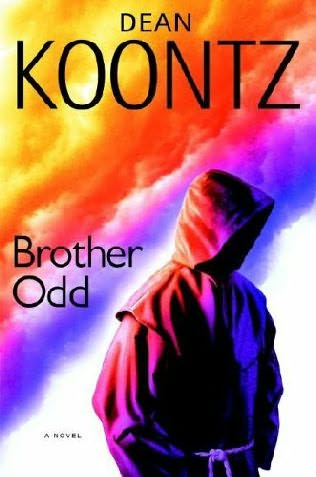
Book Title & Author: Brother Odd by Dean Koontz
Published: 2006

http://johndbrown.com/wp-content/uploads/2009/01/brother-odd-by-dean-koontz.jpg
The first time I remember hearing about Dean Koontz was when I bought one of his books for Justin's best man as a wedding gift.  Then, about six months later, Justin and I were in a used bookstore and saw a huge shelf of Dean Koontz books.  Justin knew that he enjoyed the Odd Thomas series, so we picked up a few.

They make great reading material for car trips.  I drive, Justin reads aloud, time flies!


But anyway, on to the book.  :)

Brother Odd is the third book in the Odd Thomas series.  The main character's first name is Odd and his last name is Thomas, hence the titles of the books.  In the first book, we learned that Odd can see the dead, usually those who have been killed and want justice.  He sees it as his duty to help them - since nobody else can see the dead, he's their last hope for peace.

In Brother Odd, Odd has gone to a monastery to get away from all the death in the world.  Of course, if that worked, it wouldn't be a very interesting book!  It's impossible for me to tell much about the plot, but it involves the supernatural and quantum mechanics.

These books are definitely not Christian, though they are thought-provoking.  Much like the Harry Potter books or The Chronicles of Narnia, the books are set in a world like this one, but with the difference that Odd Thomas can see dead people.  This has nothing to do with summoning people from beyond the grave or anything else demonic; instead, the ghosts just appear and need his help.  This allows the author to explore a huge variety of different characters with unique personalities and emotions.

Though you'll find the Odd Thomas books in the horror section, I would recommend them to people who don't typically enjoy horror stories.  They're a little creepy sometimes, but they end with hope, unlike most horror books or movies. 

Overall, I recommend the Odd Thomas series, particularly the first book (Odd Thomas).  The second book wasn't quite as good, and the third one was better than the second one, but neither hold a candle to the first book.

Wednesday, January 12, 2011

Snow in Alabama

My mom and dad say that we got 9 inches of snow here in Huntsville.  I guess they got that number from the news, since they don't live here and therefore don't know that it's less than that.  :)  Nevertheless, we did quite a bit of snow on Sunday night. I didn't get out to take pictures right away, but here's what I got:

The view from my patio, taken around 9am this morning.

The snow melting on our roof dripped down onto this bush and froze.  You can see gravel and dirt, but you probably can't see the thick coating of ice that's over it.


The snow was at about 5 inches on our patio railing, but that was on Monday morning.  It's mostly melted now, as you can see.

It's cold for Alabama!

In other news, I learned that even the most graceful people fall down sometimes.  About an hour ago, Justin was taking out the trash and slipped on the ice in our walkway.  It has a layer of water on it - slick!  I saw him go outside, waited about 5 seconds, heard a "pfftsh" noise (him falling), and contemplated checking to see if he was okay.  I then thought about how cold it is outside and decided to go after him if he wasn't back in five minutes.  He was, so it's all good.  It makes me feel better to know that I'm not the only clumsy one!  Sure, he slipped on ice and I can slip on nothing, but the point is: he slipped, too.

:)